01 / The engineering challenge
The engineering challenge
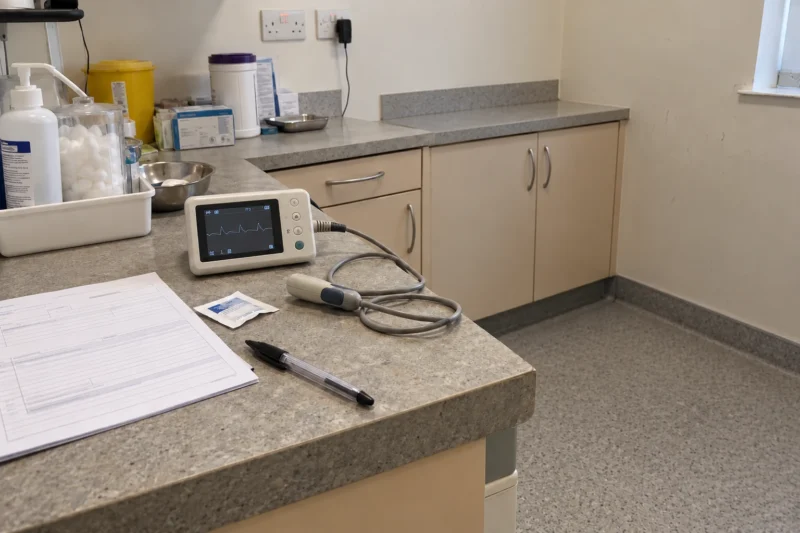
The medical project centered on contrast, fine detail and faithful image presentation. A compact screen needed to distinguish light and dark areas while supporting discernible image boundaries, fine lines and small text.
The design needed to accommodate image detail and interface information within a 3.5-inch display area, together with touch, host-interface and enclosure integration. Pixel density, contrast and viewing angle therefore needed to be considered together.
Engineering focus
Balance tonal separation, fine image detail and a clear interface within a 3.5-inch display area while integrating touch, host connections and the mechanical assembly.
02 / The customized solution
The customized solution
Displaysell placed display performance at the center of the solution: a 1200:1 typical contrast ratio for tonal separation, 1240 × 800 resolution with a 0.06 mm pixel pitch for fine detail, and a typical NTSC gamut ratio of 72% as a display-selection parameter for image presentation. A 4-lane MIPI interface, G+FF touch assembly, custom cover lens and FPC complete the equipment integration.
1200:1 Contrast for Tonal Separation
The display specifies a typical contrast ratio of 1200:1 and a minimum of 1000:1. This provides a basis for separating light and dark areas and contours, supporting the presentation of image tones and interface elements.
1240 × 800 Resolution for Fine Detail
The 3.5-inch screen contains 992,000 pixels with a 0.06 × 0.06 mm pixel pitch, corresponding to approximately 423 PPI, calculated from the pitch. The pixel density supports fine lines, small text and image edges within a compact display area.
72% NTSC Gamut Ratio for Color Presentation
At normal viewing, the NTSC gamut ratio is specified at 72% typical and 67% minimum. The solution considers this gamut parameter alongside pixel density and contrast to address color, detail and tonal relationships. Typical viewing angles are 85° in each direction at CR ≥10.
Technical specifications and customization
| Category | Item | Specification and design |
|---|---|---|
| Display | Display size | 3.5 inches |
| Display | Resolución | 1240 × 800 |
| Display | Pixel pitch | 0.06 × 0.06 mm |
| Display | Pixel density | Approx. 423 PPI, calculated from pixel pitch |
| Optical specifications | Contrast ratio | 1200:1 typical; 1000:1 minimum |
| Optical specifications | NTSC gamut ratio | 72% typical; 67% minimum; normal viewing |
| Optical specifications | Viewing angle | 85° up/down/left/right, typical at CR ≥10 |
| Display | Interfaz de pantalla | 4-lane MIPI |
| Touch configuration | Structure and controller | G+FF; GT911; I²C interface |
| Touch configuration | Power and signaling voltage | Touch power 3.3 V; signaling 3.3 V |
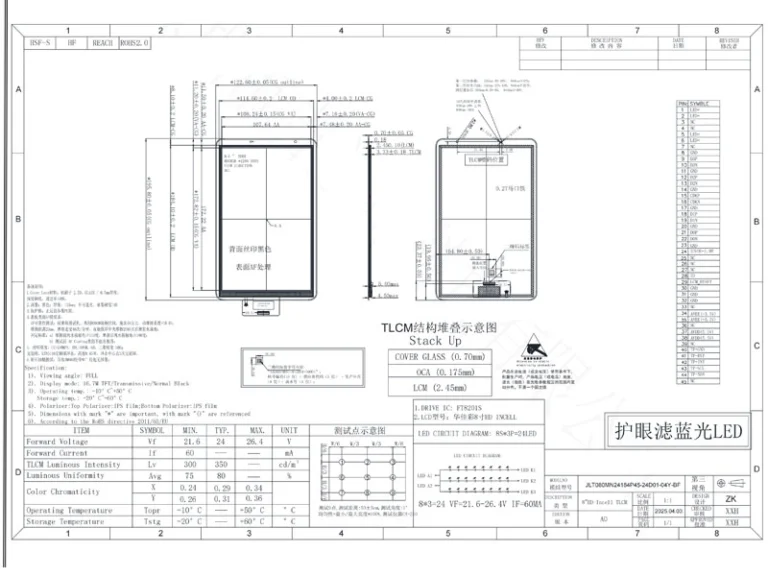
| Mechanical design | Cover lens outline | 81.85 × 60.35 mm; dimensional tolerance ±0.1 mm |
| Mechanical design | Assembly body thickness | 3.75 ± 0.2 mm |
| Custom optics | IR-window transmission | 550 nm: 5% ± 1%; 850 nm: >70% |
| Connection design | Grounded steel stiffener | 0.2 mm |
| Environmental specifications | Temperatura de funcionamiento | -20°C to +70°C |
| Environmental specifications | Temperatura de almacenamiento | -30°C to +80°C |
Approximately 423 PPI is calculated as 25.4 ÷ 0.06; it is not a separately measured datasheet value. The NTSC gamut ratio is specified at normal viewing (θ=0), and viewing angles at CR ≥10. IR transmission applies only to the designated cover-lens window, and 3.3 V only to touch power and signaling.
03 / The project result
The project result
The project translated its contrast, fine-detail and image-presentation requirements into a single custom display configuration. A 1200:1 typical contrast ratio supports tonal separation; 1240 × 800 resolution at approximately 423 PPI supports detail within a compact screen; and a typical NTSC gamut ratio of 72% provides a specified basis for color presentation. The custom touch assembly, cover lens and FPC complete the integration design.
Fine-detail displays for medical equipment require pixel density, tonal separation and color presentation to be considered together. This case connects image-presentation needs with display selection and integration through defined resolution, contrast and gamut specifications.