01 / Challenge
Challenge
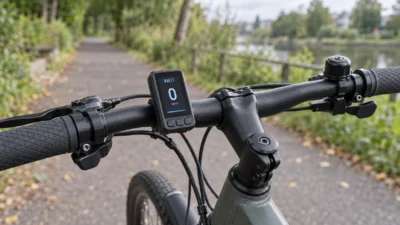
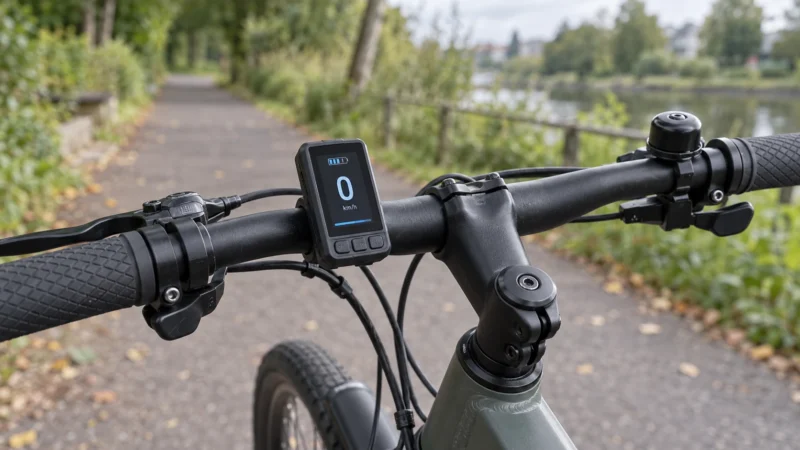
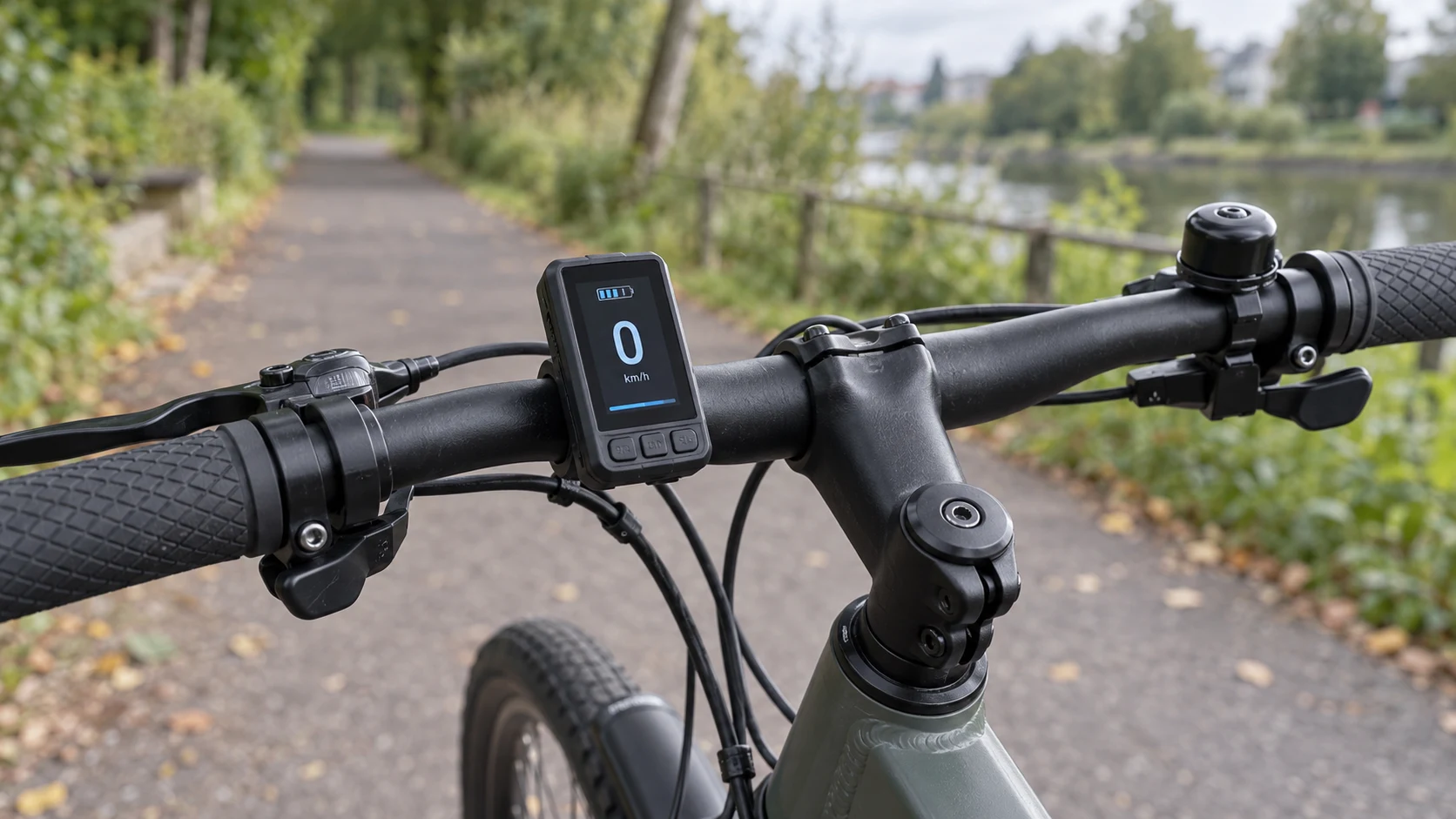
A bicycle instrument needs to present key riding information within a compact handlebar enclosure. The interface must make efficient use of its display area while accommodating different mounting angles and a constrained controller layout. This application concept uses the 91-01901-002 display assembly as the basis for a compact portrait instrument.
02 / Solution
Solution
A 1.9-inch portrait display with a defined mechanical stack
The 170 × 320 pixel format provides a portrait canvas for a prominent speed field and secondary status icons. The LCD active area measures 22.70 × 42.72 mm. A simple hierarchy keeps the main value visually distinct; font size and symbol density should be checked on a physical prototype at the intended viewing distance.
Contrast and viewing angle as design inputs
The optical specification lists a 900:1 typical contrast ratio, with 700:1 minimum, and typical viewing angles of 80° in each direction at CR ≥10. These values provide a basis for assessing the intended mounting position. Outdoor readability also depends on ambient light, cover reflections and the completed housing, so it requires evaluation on the assembled instrument.
Match the controller, cover and enclosure together
The engineering drawing specifies an 8-bit MCU connection, a 30-pin FPC and an ST7789V2 or comparable display driver. LCD supply is specified at 2.8–3.3 V. The cover-glass outline is 33.88 × 56.06 mm, with 3.10 mm nominal assembly thickness. The drawing includes 1.50 mm aluminosilicate cover glass and a 0.18 mm OCA layer. These dimensions guide enclosure clearance and FPC routing; they do not establish an ingress or impact rating.
Technical specifications
| Item | Especificación |
|---|---|
| Model | 91-01901-002; Rev.A; 2022-12-17 |
| Display size | 1.9 inch |
| Resolución | 170 × 320 |
| LCD active area | 22.70 × 42.72 mm |
| Cover outline | 33.88 × 56.06 mm (drawing) |
| Assembly thickness | 3.10 ±0.20 mm (drawing) |
| Interfaz | 8-bit MCU |
| FPC | 30-pin; 0.50 mm pitch |
| Driver | ST7789V2 or comparable |
| LCD supply | 2.8–3.3 V |
| Contrast | 900:1 typical; 700:1 minimum |
| Viewing angles | 80° U/D/L/R typical; CR ≥10 |
| Tiempo de respuesta | 30 ms typical; 35 ms maximum |
| NTSC ratio | 65% typical; 60% minimum |
| Temperatura de funcionamiento | −20°C to +70°C |
| Temperatura de almacenamiento | −30°C to +80°C |
Reliability requirements
| Requirement | Condition |
|---|---|
| High-temperature operation | 70°C; 120 h |
| High-temperature storage | 80°C; 120 h |
| Low-temperature operation | −20°C; 120 h |
| Low-temperature storage | −30°C; 120 h |
| Humidity | 40°C / 90%RH; 120 h |
| Thermal shock | −20°C →25°C →70°C; 0.5 h /5 min /0.5 h; 10 cycles |
| ESD | HBM ±8 kV (330 Ω /150 pF); MM ±200 V (200 pF /0 Ω) |
These are datasheet requirements, not completed bicycle project test results. Final inspection follows 24 hours at room temperature after the specified tests.
03 / Result
Result
This configuration combines a compact portrait format, specified optical performance and a defined cover-glass assembly for bicycle instrument development. It gives the engineering team concrete inputs for interface layout, controller matching and enclosure design. The next step is prototype evaluation covering readability, electrical operation and the final device environment.
Discuss Your Bicycle Display Project
Share your instrument drawing, host interface, viewing conditions and environmental requirements with Displaysell. Our team can review the display assembly and integration options for your design.