

When selecting an LCD display for industrial equipment, many buyers come across two terms: OCA Bonding display and Air Bonding display.
Both technologies are commonly used in display modules, but they work in different ways and offer different benefits. Understanding the difference can help you choose the right display for your product, especially if the device will be used in demanding environments such as outdoor equipment, industrial machines, or medical devices.
In this article, we explain the key differences between OCA bonding and air bonding in simple terms, and help you decide which option may be better for your application.
What Is OCA Bonding?
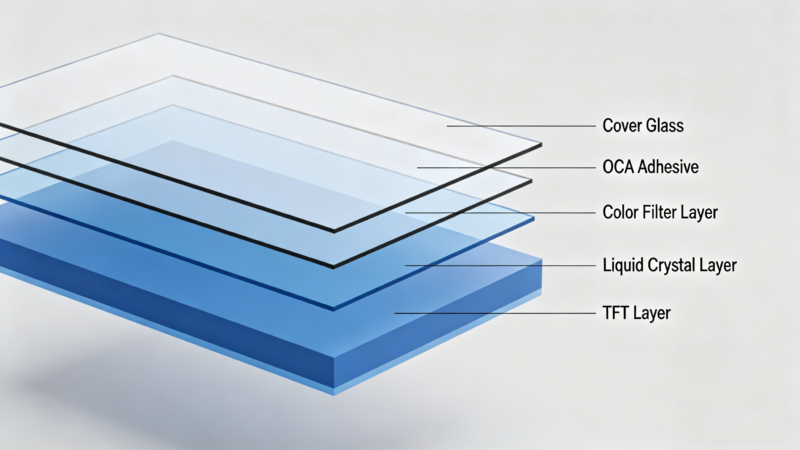
OCA bonding (Optically Clear Adhesive bonding) is a display lamination process where a transparent adhesive layer is used to bond the touch panel or cover glass directly to the LCD screen.
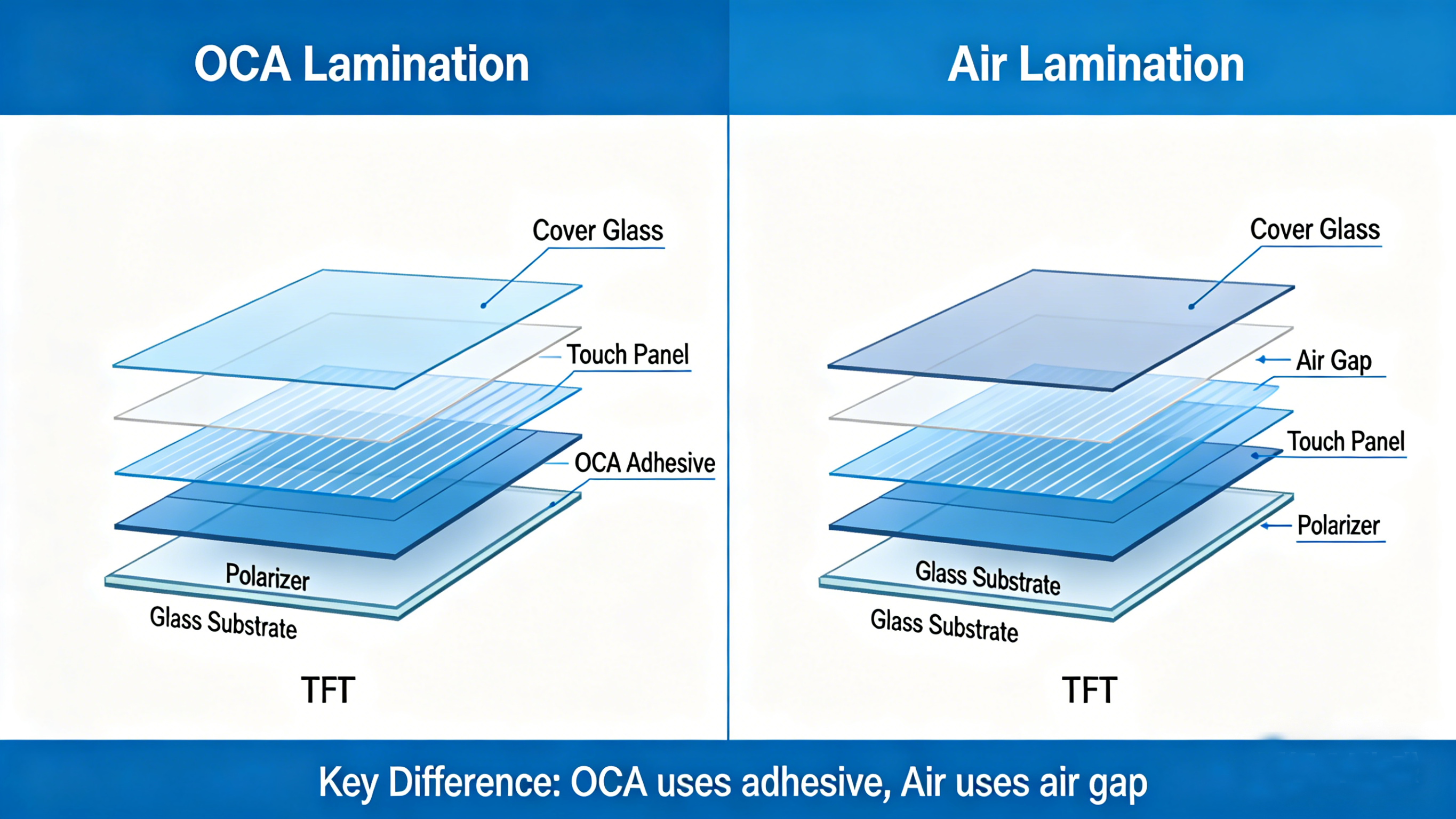
In a traditional display structure, there is usually a small air gap between the LCD and the protective glass. With OCA bonding, this air gap is removed and replaced with a clear optical adhesive.
Because the adhesive layer is highly transparent, light passes through the display more efficiently. This improves visual performance and reduces internal reflections.
Better brightness and contrast
Reduced reflections
Improved visibility in sunlight
Stronger structural stability
As a result, displays with OCA bonding usually offer:
These advantages make OCA bonding popular in industrial, medical, and outdoor devices.
What Is Air Bonding?
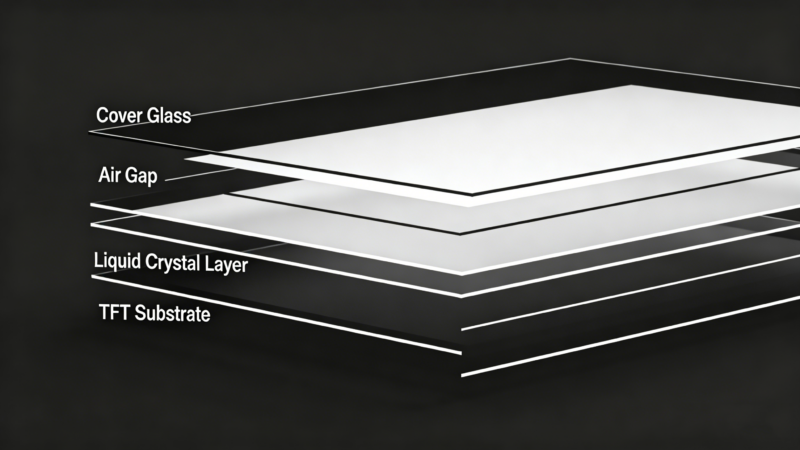
Air bonding is the traditional way of assembling LCD modules. In this method, the touch panel or cover glass is mounted above the LCD screen with a small air gap between the two layers.
This structure is easier to manufacture and usually costs less than optical bonding.
Air bonded displays are commonly used in many consumer electronics and indoor devices where extreme environmental performance is not required.
Typical characteristics of air bonding include:
Lower manufacturing cost
Easier repair and replacement
Simpler production process
However, because the display layers are separated by air, light reflections inside the module may reduce display clarity in bright environments.
OCA Bonding vs Air Bonding: Key Differences on LCD bonding technology
The main difference difference between optical bonding and air gap display is whether there is an air gap inside the display structure.
| Feature | OCA Bonding | Air Bonding |
| Display clarity | Higher | Moderate |
| Sunlight readability | Excellent | Limited |
| Internal reflection | Very low | Higher |
| Structural strength | Stronger | Standard |
| Cost | Higher | Lower |
| Repairability | More difficult | Easier |
For buyers who are not familiar with display technology, the simplest way to understand it is:
OCA bonding improves display quality and durability, while air bonding focuses on cost efficiency.
Why Industrial Equipment Often Uses OCA Bonding
Industrial devices often operate in challenging environments. Displays may be exposed to sunlight, vibration, dust, or temperature changes.
Because OCA bonding removes the air gap inside the display, it helps reduce several common problems that occur in harsh conditions.
For example:
Less internal reflection improves outdoor readability
The bonded structure improves vibration resistance
Reduced air space helps prevent dust or moisture from entering the display layers
For applications such as industrial control panels, outdoor equipment, and medical devices, these advantages can improve long-term reliability.
When Air Bonding May Be the Better Choice
Despite its advantages, OCA bonding is not always necessary.
For many applications, especially indoor devices, air bonding can still be a practical and cost-effective solution.
Air bonding may be suitable when:
The device is mainly used indoors
Cost control is a priority
High sunlight readability is not required
The product design requires easier repair or replacement
For example, some consumer devices, small appliances, or indoor control panels can perform well with an air bonded display.
How to Choose the Right Display for Your Product
If you are evaluating display options for a new product, the best choice usually depends on your product environment and budget.
You may consider the following questions:
Will the display be used outdoors?
Is sunlight readability important?
Does the device experience vibration or harsh conditions?
Is cost a major concern for the project?
If your product needs strong durability and clear visibility, OCA bonding may be the better option.
If cost efficiency and simple design are the priority, air bonding may be sufficient.
Working with an experienced display supplier can also help you evaluate the best solution based on your application.
Frequently Asked Questions
Is OCA bonding the same as optical bonding?
OCA bonding is a type of optical bonding technology that uses a transparent adhesive layer to eliminate the air gap between the LCD and the cover glass. It helps improve display clarity and reduce reflections.
Why does OCA bonding improve sunlight readability?
In air bonded displays, light reflects between the glass and the LCD surface. OCA bonding removes the air gap and reduces these reflections, which improves contrast and visibility under bright light.
Is OCA bonding more expensive than air bonding?
Yes. OCA bonding requires additional materials, clean-room lamination equipment, and a more complex manufacturing process. However, it provides better optical performance and durability.
Do all industrial displays need optical bonding?
Not necessarily. Many indoor industrial devices can work well with air bonded displays. Optical bonding is typically used when higher visibility, durability, or environmental resistance is required.

