
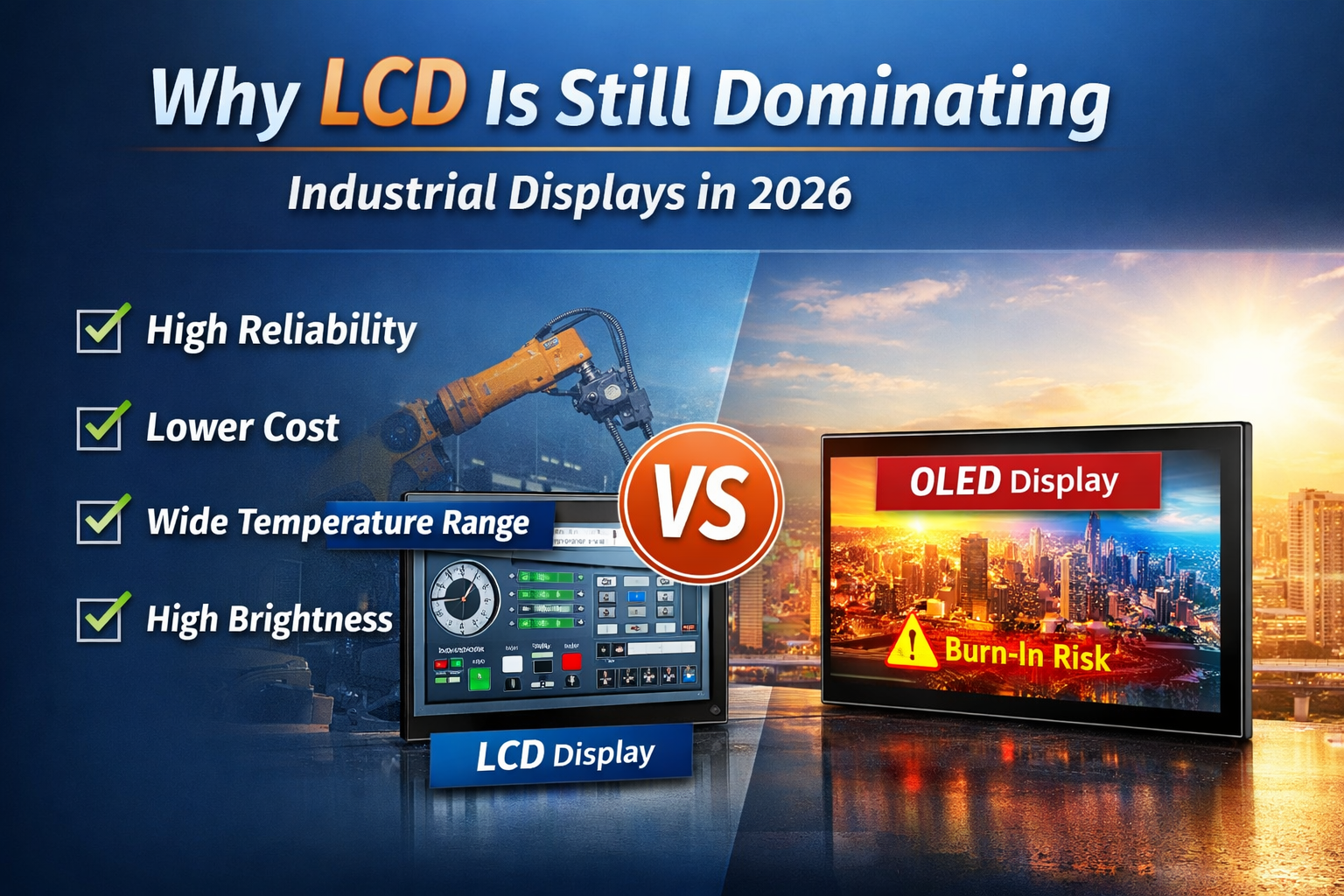
Display technology has evolved rapidly over the past decade. OLED screens have become popular in smartphones, televisions, and consumer electronics thanks to their vibrant colors and deep contrast.
However, when it comes to industrial applications, LCD technology still remains the most widely used display solution.
From industrial automation systems to medical equipment and outdoor devices, many manufacturers continue to rely on industrial LCD displays because they offer advantages in reliability, cost, brightness, and lifecycle.
In this article, we explore why LCD continues to dominate the industrial display market in 2026 and how it compares with OLED technology.
LCD vs OLED: Understanding the Key Differences
Before discussing industrial applications, it's helpful to understand the fundamental differences between LCD and OLED technologies.
LCD (Liquid Crystal Display) uses a backlight to illuminate liquid crystal layers that control how light passes through the panel.
OLED (Organic Light Emitting Diode) uses self-emitting pixels, meaning each pixel produces its own light without a backlight.
OLED displays are known for their:
Excellent contrast ratio
Thin panel design
Fast response times
However, industrial environments require more than visual performance. Equipment manufacturers must consider factors like durability, cost, supply stability, and environmental conditions.
This is where LCD displays continue to show clear advantages.
Higher Reliability for Industrial Equipment
Industrial devices are often designed to operate continuously for many years, sometimes 24 hours a day.
One challenge with OLED technology is image retention or burn-in, which can occur when static elements remain on the screen for long periods.
Industrial interfaces frequently display fixed content such as:
control panels
machine status indicators
dashboards
monitoring systems
LCD technology does not suffer from permanent burn-in in the same way, making it a more reliable option for applications with static images.
Because of this, many engineers still prefer industrial LCD displays for mission-critical equipment.
Lower Cost for Large-Scale Deployment
Cost is another important factor in industrial product development.
Compared with OLED panels, LCD displays typically offer:
Lower panel cost
More mature manufacturing processes
Competitive pricing for medium and large sizes
For manufacturers producing thousands of units of industrial equipment, the difference in display cost can significantly impact the total product price.
As a result, many companies continue to select TFT LCD modules for control systems, embedded devices, and automation equipment.
Better Performance in Wide Temperature Environments
Industrial equipment often operates in environments that consumer electronics are not designed for.
Typical industrial requirements include operating temperatures such as:
−20°C to 70°C
−30°C to 80°C
even lower temperatures for specialized applications
OLED displays can experience performance degradation in extremely low temperatures.
By contrast, wide-temperature LCD displays are commonly designed for harsh environments and are widely used in:
industrial control systems
outdoor machinery
transportation equipment
energy and power systems
This makes LCD a more dependable choice for demanding working conditions.
High Brightness for Outdoor Applications
Many industrial devices are used outdoors or in bright environments where screen visibility is critical.
Examples include:
EV charging stations
agricultural machinery
marine equipment
construction machines
Industrial LCD displays can easily achieve brightness levels such as:
1000 nits
1500 nits
even higher with specialized backlight systems
When combined with technologies like optical bonding or anti-reflection glass, LCD displays can become highly effective sunlight readable displays.
This capability is essential for equipment used in direct sunlight.
Longer Product Lifecycle and Stable Supply
Consumer electronics evolve rapidly, but industrial equipment often has a product lifecycle of 5 to 10 years or longer.
Manufacturers need display components that remain available for long periods.
LCD panels are widely produced across the display industry, which helps ensure:
stable supply chains
long-term availability
easier product maintenance and replacement
Many industrial LCD panels are supported with extended lifecycle programs, making them ideal for equipment manufacturers who need reliable long-term sourcing.
Common Applications of Industrial LCD Displays
Because of their durability and flexibility, LCD displays are used in a wide range of industrial sectors, including:
Industrial automation equipment
Medical devices
EV charging stations
Agricultural machinery
Energy control systems
Transportation and logistics equipment
In many of these applications, performance stability is more important than ultra-high contrast or ultra-thin design.
LCD technology continues to meet these requirements effectively.
Conclusion: LCD Remains the Practical Choice for Industrial Displays
Although OLED technology continues to grow in consumer electronics, LCD displays remain the most practical and widely adopted solution for industrial applications.
Their advantages in reliability, cost efficiency, temperature tolerance, brightness, and long-term supply make them well suited for demanding environments.
As industrial automation, smart equipment, and connected devices continue to expand, industrial LCD displays will remain a key component of modern machinery well beyond 2026.

