
Introduction
Electromagnetic interference (EMI) is one of the most common yet underestimated issues in display integration.
Whether in industrial control systems, automotive electronics, or outdoor equipment, poor EMI design can lead to:
Screen flickering
Touch malfunction
Signal instability
System-level certification failure
This guide provides a complete overview of EMI shielding in LCD modules — including design principles, shielding levels, and practical solutions.
What Is EMI Shielding?
EMI shielding refers to techniques used to reduce electromagnetic interference that can affect electronic devices.
A key concept in evaluating shielding performance is:
Shielding Effectiveness
It is typically measured in decibels (dB), which indicates how much interference is attenuated.
Why EMI Matters in LCD Display Modules
Modern display modules (especially high-resolution and high-brightness panels) are highly sensitive to electromagnetic noise.
Common EMI Issues in Displays
Flickering or unstable images
Touch panel drift or failure
LVDS / signal transmission errors
Increased system noise
These issues become more critical in:
High brightness displays (1000 nits+)
Wide temperature environments
Compact embedded systems
Where EMI Problems Typically Occur
In LCD modules, EMI sources are usually concentrated in:
Display driver IC
Backlight power circuits
Signal interfaces (LVDS / RGB / MIPI)
External components (motors, power supplies)
Key Factors That Define EMI Requirements
Before designing shielding, EMI requirements must be clearly defined based on:
1. Application Environment
Industrial
Automotive
Medical
Military
2. EMC Standards
Different industries follow different standards:
CISPR 25 (automotive electronics)
ISO 11452
MIL-STD-461
3. Frequency Range
Shielding effectiveness varies significantly depending on frequency.
4. Shielding Effectiveness (dB)
For example:
10–20 dB → basic protection
20–40 dB → industrial level
40 dB → high-reliability systems
EMI Shielding Levels in LCD Design
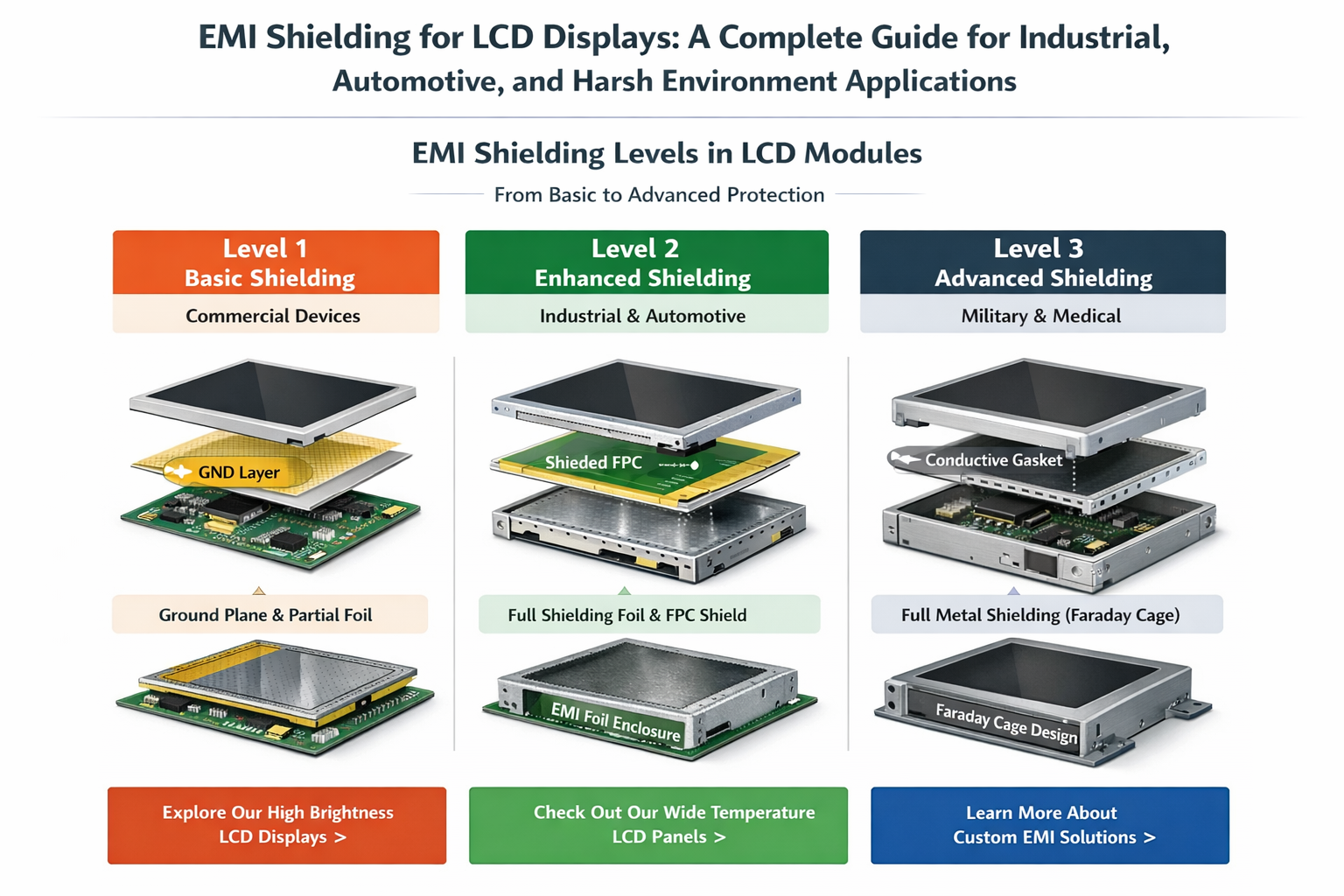
Although there is no universal classification, EMI solutions are typically divided into three levels:
Level 1: Basic Shielding (Commercial Use)
Applications:
Indoor devices
Standard industrial equipment
Design Approach:
Ground plane optimization
Partial copper foil shielding
Basic filtering
Level 2: Enhanced Shielding (Industrial & Automotive)
Applications:
Industrial control systems
Automotive displays
Outdoor equipment
Design Approach:
Full-area EMI foil coverage
Shielded FPC design
Multi-point grounding
Signal integrity optimization (LVDS)
Level 3: Advanced Shielding (High-Reliability Systems)
Applications:
Military equipment
Medical systems
Aerospace / high-end automotive
Design Approach:
Full enclosure shielding structure
Faraday Cage
Metal frame + conductive foam
360° grounding
Shielded connectors
How EMI Shielding Is Implemented in LCD Modules
1. Shielding Materials
Copper foil
Aluminum foil
Conductive fabric
2. Grounding Design (Critical Factor)
Proper grounding determines actual EMI performance:
Single-point grounding vs multi-point grounding
Ground loop control
Connection to system chassis
3. Signal Optimization
Differential signaling (LVDS)
Impedance control
Shorter signal paths
4. Structural Design
Shield coverage area
Enclosure integration
Mechanical assembly
Common Mistakes in EMI Design
Many EMI failures are caused by:
Adding shielding material without grounding
Incomplete shielding coverage
Ignoring system-level EMI
Poor cable or connector design
Result: Shielding exists, but does not work effectively
How to Choose the Right EMI Solution
When selecting or customizing an LCD module, always confirm:
Application environment
Required EMC standards
Target shielding performance (dB)
System-level vs module-level requirements
Any existing interference issues
Conclusion
EMI shielding is not just about adding copper foil — it is a system-level engineering process involving materials, grounding, signal design, and structure.
A well-designed EMI solution ensures:
Stable display performance
Reliable touch response
Successful EMC certification
Long-term system stability
Looking for EMI-Optimized LCD Displays?
We provide custom LCD display modules designed for demanding environments:
High brightness (1000 nits+)
Wide temperature (-30°C to 80°C)
Industrial & automotive applications
Customized EMI shielding solutions
Contact us for technical support and tailored designs.

