
As an LCD manufacturer with over 15 years of experience supplying TFT displays for industrial, outdoor, and embedded applications, we often see the same issue repeated across different projects:
the LCD is used outside its rated temperature range.
In many cases, the display itself is not “defective.” Instead, it is operating in an environment it was never designed for. This article explains the most common LCD failures caused by temperature mismatch, why they happen, and—more importantly—how to avoid them at the design stage.
Why the Rated Temperature Range of an LCD Is Critical
The Liquid Crystal Display temperature range defines the environmental conditions under which the display can maintain stable optical performance and long-term reliability.
When an LCD operates outside this range, problems may appear immediately or gradually over time, including:
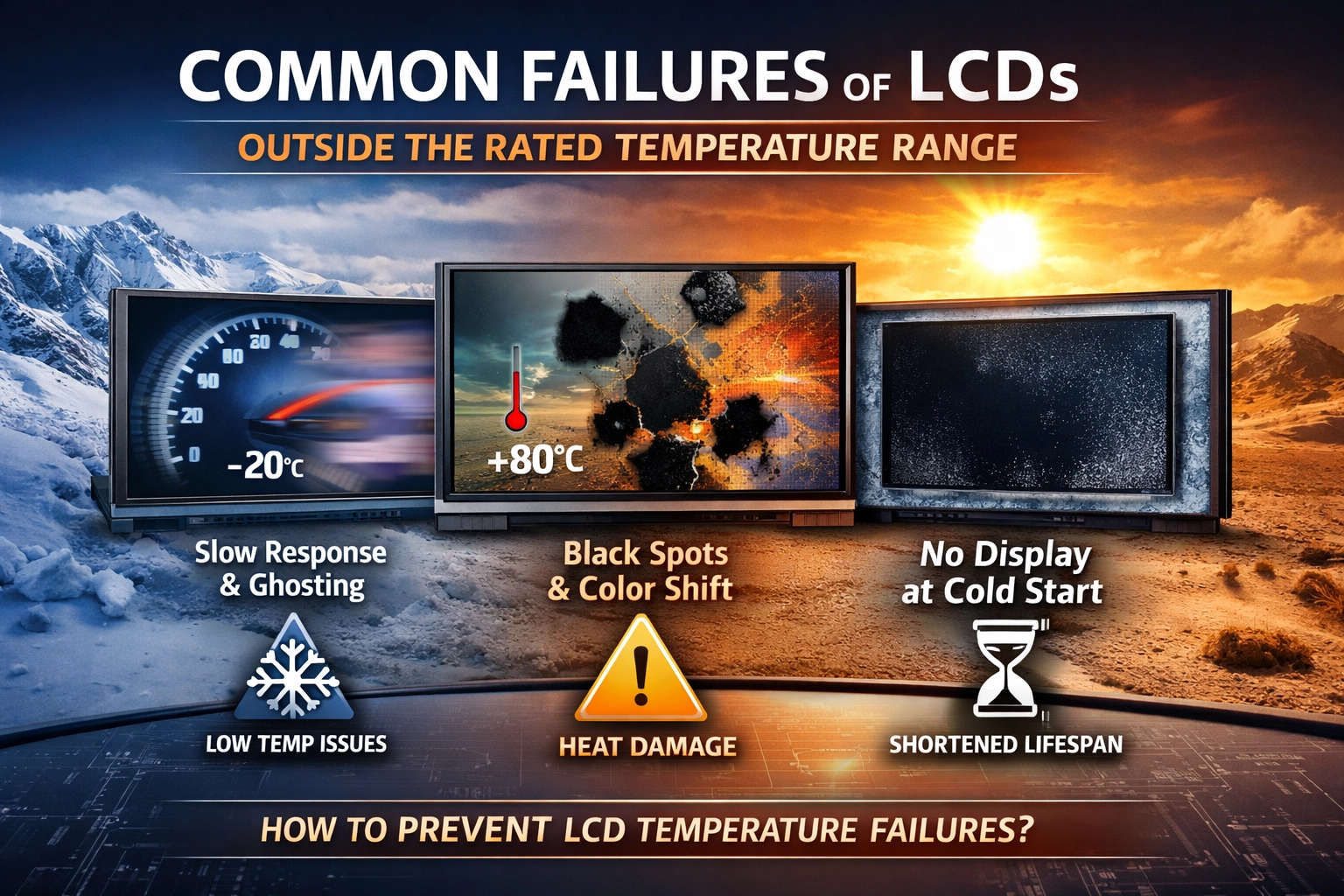
Slow or incomplete image response
Contrast and color shift
Permanent image artifacts
Shortened product lifespan
From a factory perspective, temperature-related failures account for a large percentage of post-deployment display issues, especially in industrial and outdoor products.
Common LCD Failures at Low Temperatures
Slow Response Time and Image Smearing
At low temperatures, liquid crystal molecules become more viscous. This directly leads to:
Slow pixel response
Motion blur or smearing
Ghosting during screen transitions
This is frequently observed when standard temperature LCDs (0~50°C) are used in environments below freezing.
How to avoid it:
Select wide-temperature LCDs (e.g. -20~70°C or -30~80°C)
Use liquid crystal materials optimized for low-temperature response
Validate performance during cold-start testing, not only steady-state testing
Display Does Not Turn On at Cold Start
In extremely low temperatures, some LCDs may appear “dead” during power-up. This is usually caused by:
LC material not responding fast enough
Driver IC timing mismatch at low temperature
How to avoid it:
Choose displays with verified cold-start performance
Confirm the operating temperature range, not only the storage range
Work with manufacturers who conduct real low-temperature power-on tests
Common LCD Failures at High Temperatures
Contrast Degradation and Color Shift
High temperatures accelerate molecular movement in liquid crystal materials, resulting in:
Reduced contrast ratio
Washed-out colors
Inconsistent grayscale performance
This issue is common in outdoor, enclosed, or sun-exposed devices where internal temperatures rise significantly.
How to avoid it:
Use high-temperature LC formulations
Select polarizers rated for elevated temperatures
Evaluate optical performance at maximum operating temperature, not just room temperature
Permanent Black Spots or Image Non-Uniformity
Prolonged exposure to temperatures above the rated limit may cause:
Irreversible damage to liquid crystal alignment
Polarizer shrinkage or deformation
Localized dark or bright spots
These failures are often permanent and non-repairable.
How to avoid it:
Maintain adequate thermal design (ventilation, heat spreading)
Avoid placing the LCD near heat sources (CPU, power modules)
Choose displays with proven high-temperature aging data
Long-Term Reliability Issues Caused by Temperature Stress
Accelerated Aging and Reduced Lifespan
Even if an LCD appears functional outside its rated temperature range, long-term operation may lead to:
Faster brightness decay
Early backlight failure
Increased risk of field returns
From a manufacturing standpoint, this is one of the most underestimated risks.
How to avoid it:
Design with sufficient temperature margin
Conduct thermal cycling and aging tests
Partner with suppliers who understand both LC materials and backlight reliability
How Experienced LCD Manufacturers Prevent Temperature-Related Failures
As a TFT LCD factory, temperature reliability is not addressed by a single component—it requires system-level coordination, including:
Liquid crystal material selection
Polarizer and optical film matching
Driver IC compatibility
Backlight thermal management
Process control and validation testing
Displays designed for wide-temperature operation are not simply “standard panels with a wider label”. They require deeper material knowledge and manufacturing experience.
Choosing the Right LCD Temperature Range for Your Application
Before selecting an LCD, we recommend answering these questions:
What is the real operating temperature inside the enclosure?
Is cold-start performance required?
Is the product exposed to direct sunlight or enclosed heat sources?
What is the expected product lifetime?
Answering these early can prevent costly redesigns later.
Final Thoughts from the Manufacturer’s Perspective
Operating an LCD outside its rated temperature range is one of the most common—and avoidable—causes of display failure.
With proper selection and early collaboration, most temperature-related issues can be eliminated before mass production.
If your application involves industrial, outdoor, or harsh environments, choosing the correct Liquid Crystal Display temperature range is not optional—it is essential.

