
In industrial equipment, operators rarely look at a screen from a perfect front angle.
Unlike consumer devices, HMI panels, control terminals and outdoor machines are viewed from multiple positions, distances and lighting conditions.
This is why wide viewing angle TFT LCD technology has become a critical requirement in modern industrial display design.
As a TFT LCD manufacturer with 15 years of experience, we frequently see projects fail field testing not because of resolution or brightness — but because the screen becomes unreadable when viewed from the side.
Why Viewing Angle Matters More in Industrial HMI Than in Consumer Displays
Industrial environments introduce viewing conditions that consumer electronics rarely face.
Multi-Operator Observation
In production lines or control rooms, several operators observe the same screen simultaneously.
Narrow viewing angle panels cause:
Color inversion
Washed-out contrast
Misreading of data
This can directly affect operational safety.
Installation Constraints
Unlike tablets or phones, HMI screens are mounted:
on vertical cabinets
above eye level
inside machines
at operator standing positions
The user cannot adjust their viewing angle — the display must adapt to them.
Outdoor and Semi-Outdoor Usage
For kiosks, EV chargers, and agricultural machines:
sunlight shifts contrast perception
operators view from side positions
polarized sunglasses worsen narrow-angle panels
This is where wide viewing angle IPS panels become essential rather than optional.
Technologies Behind Wide Viewing Angle TFT LCD
Not all TFT panels behave the same.
The panel mode determines usability in real industrial conditions.
TN Panels (Traditional TFT)
Typical viewing angle: 45°–60°
Limitations:
Strong color shift
Top/bottom inversion
Poor multi-viewer readability
Suitable only for cost-driven, single-viewer devices.
VA / MVA Panels
Typical viewing angle: 80°–85°
Improvement in contrast, but still angle-dependent brightness variation.
Used in mid-level industrial equipment.
IPS Panels (Recommended for HMI)
Typical viewing angle: 85°/85°/85°/85°
Advantages:
True color consistency
No grayscale inversion
Stable contrast across positions
Compatible with optical bonding
This is why rugged HMI IPS panels have become the mainstream choice in high-end equipment.
Wide Viewing Angle + Touch Integration Challenges
Many projects underestimate this:
Wide viewing angle alone does not guarantee usability.
Touch integration must match the optical design.
Common problems we help customers solve:
Polarizer & Touch Sensor Conflict
Incorrect stack design causes:
rainbow effect
reduced brightness
touch accuracy drift
H3: Outdoor Glove Operation
Industrial environments require:
water tolerance
thick glove touch
EMI immunity
Optical Bonding for Outdoor Readability
Combining IPS + optical bonding enables:
reduced reflection
improved contrast under sunlight
stable viewing from angles
As a display manufacturer and touch solution provider, we tune the controller IC and sensor pattern based on the final application — not only the panel spec.
Typical Applications Requiring Wide Viewing Angle Displays
Industrial customers usually request IPS after field testing failures.
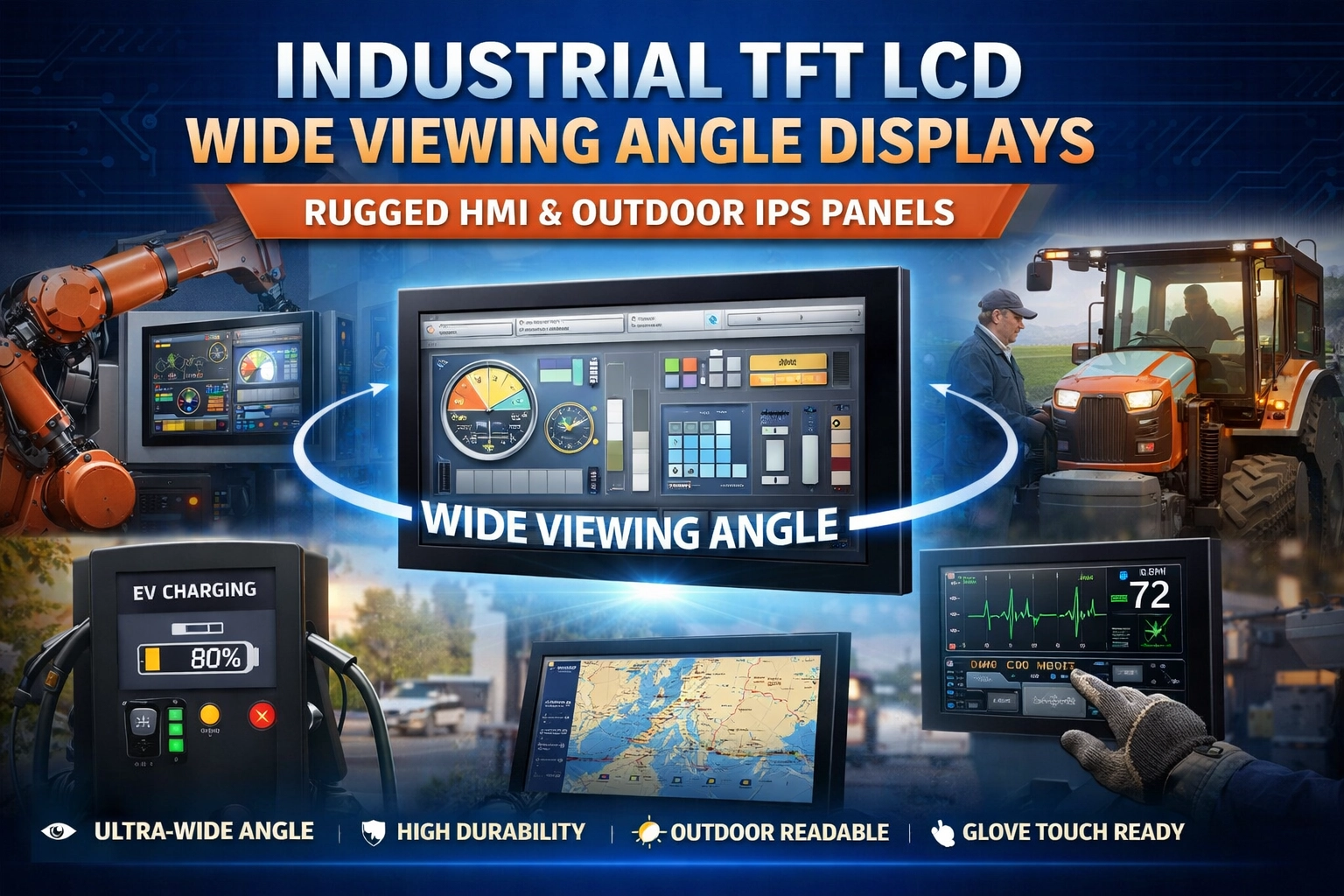
Common applications include:
Industrial control HMI panels
EV charging stations
Medical monitoring equipment
Smart agriculture machinery
Marine navigation displays
Outdoor kiosks and ticketing machines
In these devices, readability from different positions matters more than resolution.
Choosing the Right Industrial TFT LCD Supplier
A reliable supplier should not only provide a panel — but ensure the whole optical system works together.
Important capabilities:
Panel selection based on use environment
Touch tuning for gloves/water/EMI
Optical bonding design
Long-term supply stability
Engineering support during validation
With 15 years of TFT LCD manufacturing experience, we provide complete touch display solutions rather than standalone modules — ensuring the screen works in real machines, not just in the lab.
Conclusion
For industrial equipment, viewing angle is not a specification detail — it is a usability requirement.
Wide viewing angle IPS TFT LCD significantly improves:
operational safety
readability
outdoor usability
multi-user interaction
Choosing the correct display architecture at the design stage prevents costly redesign later in the project.
If your HMI device will be viewed from different positions or used outdoors, selecting an industrial wide viewing angle TFT LCD solution is the most reliable approach.

