
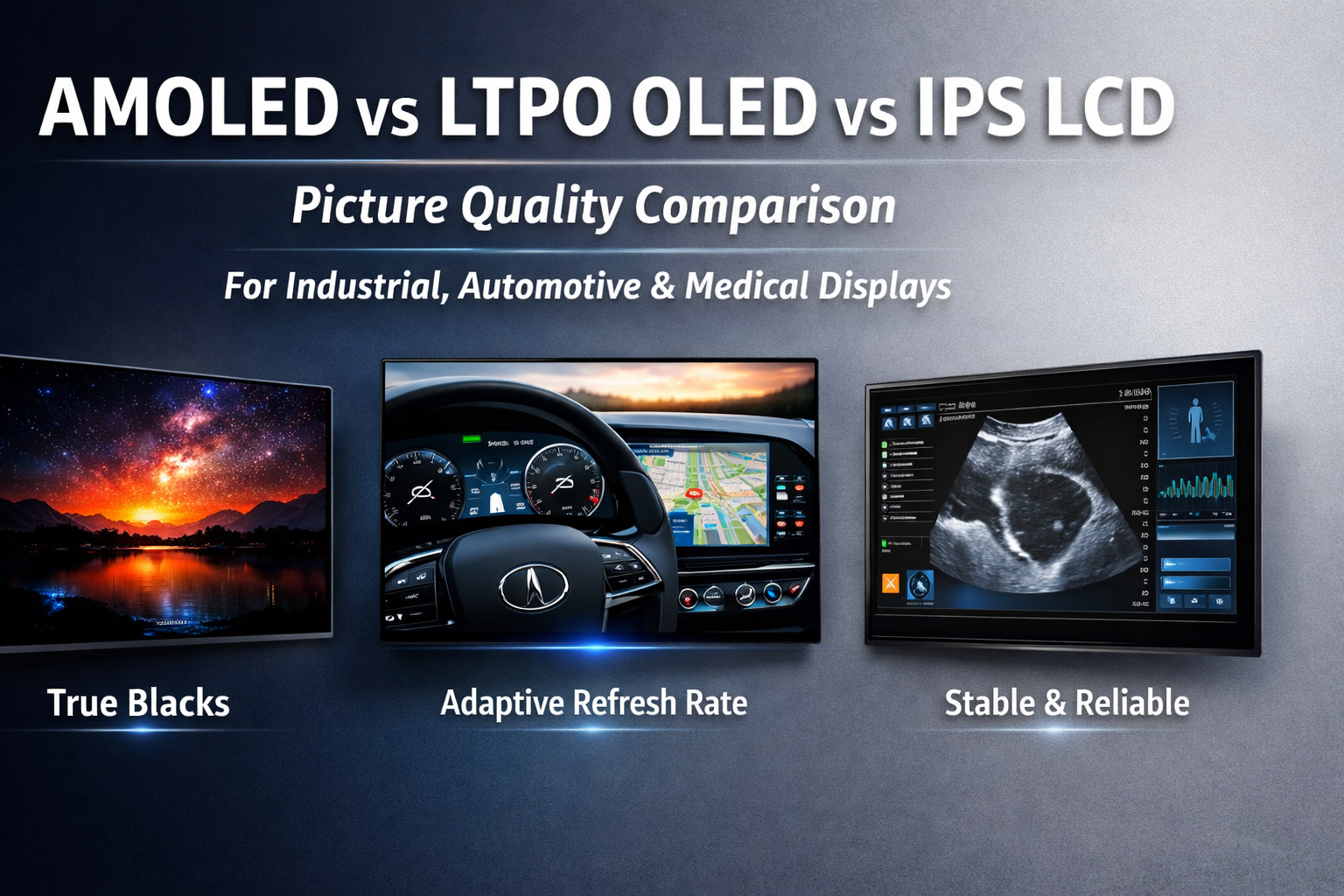
When selecting a display for industrial, automotive, or medical applications, picture quality means more than sharp images.
It affects readability, safety, long-term reliability, and user comfort in real-world environments.
This article compares AMOLED, LTPO OLED, and IPS LCD from a professional perspective, focusing on picture quality factors that matter in 24/7 operation, harsh environments, and regulated applications.
1)What “Picture Quality” Means in Professional Applications
In industrial and medical use, picture quality includes:
Stable brightness over long operating hours
Clear visibility under strong ambient light
Accurate and consistent color reproduction
Wide viewing angles for shared screens
Long-term image stability without degradation
Resolution alone does not define picture quality in these applications.
2)Brightness and Outdoor Readability
AMOLED
AMOLED displays offer high peak brightness and excellent contrast. However, when large white areas are displayed, brightness often drops to protect the panel. This can reduce readability in outdoor or in-vehicle environments.
LTPO OLED
LTPO OLED has similar brightness performance to AMOLED but provides smoother brightness control. While this improves user experience, sustained high brightness is still limited compared to LCD.
IPS LCD
IPS LCD panels can maintain stable high brightness for long periods, making them well suited for sunlight-readable automotive and industrial displays.
Best choice for sustained brightness: IPS LCD
3)Contrast Ratio and Black Performance
AMOLED / LTPO OLED
Both technologies use self-emissive pixels, enabling true black levels and extremely high contrast. This improves visibility in dark environments and night-mode interfaces.
IPS LCD
IPS LCD relies on backlight systems, so black levels appear lighter. However, contrast performance remains consistent and predictable.
Best contrast performance: AMOLED / LTPO OLED
4)Color Accuracy and Visual Consistency
AMOLED
Colors are vivid and saturated, which can be visually impressive. However, color accuracy may shift over time due to panel aging.
LTPO OLED
LTPO OLED offers better control over refresh behavior, which helps maintain more stable visual performance, but it does not eliminate OLED aging effects.
IPS LCD
IPS LCD provides natural and stable color reproduction, making it a preferred choice for medical imaging, diagnostics, and control panels.
Best color stability: IPS LCD
5)Viewing Angle Performance
All three technologies support wide viewing angles, but their behavior differs:
AMOLED / LTPO OLED: Minimal color shift even at extreme angles
IPS LCD: Excellent viewing angles, with slight brightness loss at very wide angles
For shared displays in vehicles or medical equipment, all three are acceptable, with OLED having a slight advantage.
6)Motion Performance and Refresh Rate Impact
AMOLED
Fast pixel response reduces motion blur, improving clarity in dynamic interfaces.
LTPO OLED
Adaptive refresh rates help optimize visual smoothness while reducing power consumption, which is beneficial for battery-powered devices.
IPS LCD
Motion performance is stable and predictable, though response times are slower than OLED.
For industrial and medical interfaces, motion performance differences are usually not a limiting factor.
7)Uniformity and Long-Term Image Stability
OLED (AMOLED & LTPO OLED)
OLED panels may show:
Brightness non-uniformity (mura)
Image retention or burn-in over time
These effects are critical concerns in applications with static UI elements.
IPS LCD
IPS LCD panels offer better brightness and color uniformity, with no burn-in risk, making them suitable for long-life systems.
Best long-term stability: IPS LCD
8)AMOLED vs LTPO OLED: Is There a Picture Quality Difference?
From a pure image quality perspective:
AMOLED and LTPO OLED look very similar
LTPO OLED improves power efficiency and refresh rate control
For industrial and medical systems, LTPO OLED does not significantly change long-term picture quality reliability.
9)Which Display Technology Is Best for Your Application?
| Application Type | Recommended Technology | Reason |
| Industrial HMI | IPS LCD | Stability, long lifetime, no burn-in |
| Automotive Displays | IPS LCD / LTPO OLED | High brightness, reliability |
| Medical Equipment | IPS LCD | Color accuracy, consistency |
| Portable Devices | LTPO OLED | Power efficiency |
10)Conclusion
While AMOLED and LTPO OLED deliver impressive contrast and modern visual appeal, IPS LCD remains the most reliable choice for industrial, automotive, and medical displays.
In professional applications, stable picture quality over time is more important than peak visual performance.
Choosing the right display technology ensures not only better image quality, but also long-term safety and system reliability.

