
As display technologies continue to evolve, modern industrial and commercial applications demand better screen visibility, higher durability, and improved touch performance. This is especially important for outdoor equipment, medical systems, automotive displays, marine devices, and industrial control applications.
Optical bonding technology has become one of the most effective methods for improving TFT LCD display performance in harsh environments. By eliminating the air gap between the LCD panel and the cover glass, optical bonding significantly enhances sunlight readability, reduces reflection, and improves display durability.
In this comprehensive guide, we will explain what optical bonding is, how it works, its major benefits, common bonding methods, and why it is widely used in high-end LCD display solutions.
Table of Contents
- What is Optical Bonding?
- How Does Optical Bonding Work?
- Types of Optical Bonding
- Benefits of Optical Bonding
- Optical Bonding vs Air Bonding
- Common Applications
- Challenges of Optical Bonding
- FAQ
- Conclusion
What is Optical Bonding?
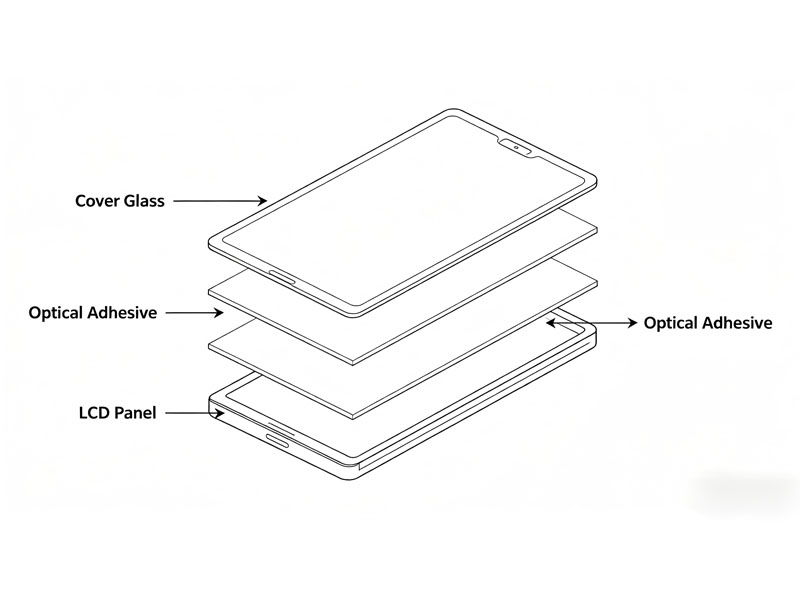
Optical bonding is a process that uses a transparent adhesive to bond the LCD display directly to the touch panel or cover glass.
Traditional display structures usually contain an air gap between the LCD and the top glass layer. This air gap can cause internal light reflection, lower contrast, and poor visibility under sunlight.
Optical bonding removes this air gap by filling it with a transparent optical adhesive such as:
- LOCA (Liquid Optical Clear Adhesive)
- OCA (Optical Clear Adhesive)
- Silicone Optical Gel
By reducing internal reflection and improving light transmission, optical bonding significantly improves display clarity and viewing performance.
Because of these advantages, optical bonding is widely used in industrial TFT LCD displays, medical monitors, automotive displays, military devices, and outdoor applications.
How Does Optical Bonding Work?
Optical bonding works by eliminating the refractive mismatch between the LCD and the cover glass.
In a traditional air-bonded display structure:
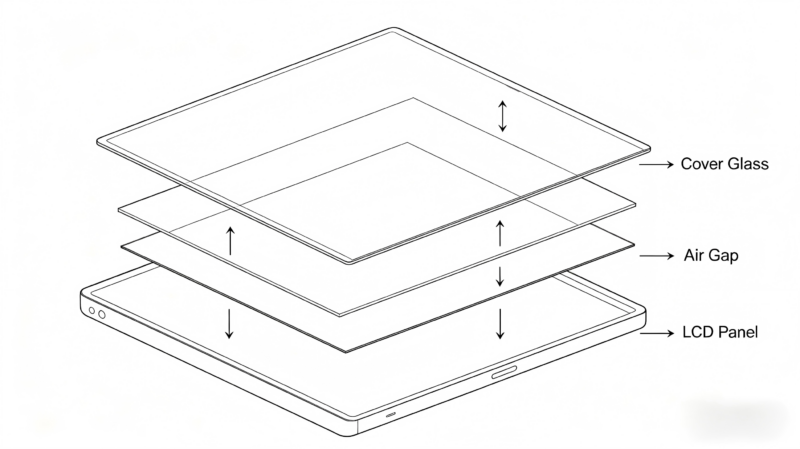
LCD Panel → Air Gap → Cover Glass
Light passes through multiple layers with different refractive indexes. The air gap causes part of the light to reflect internally, reducing brightness and image clarity.
With optical bonding, the air gap is replaced by a transparent adhesive material:
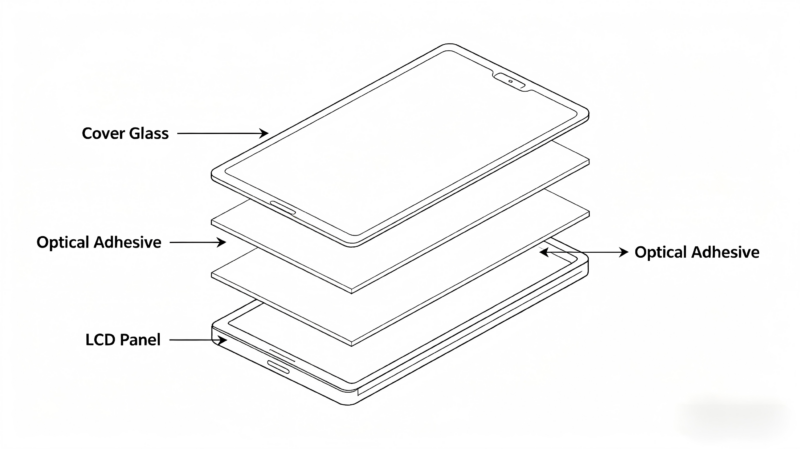
LCD Panel → Optical Adhesive → Cover Glass
Since the adhesive has a refractive index closer to glass, internal reflection is significantly reduced.
As a result:
More light reaches the user’s eyes
- Reflection is minimized
- Contrast ratio improves
- Outdoor readability becomes much better
This is why optical bonding is commonly used in sunlight-readable displays.
Types of Optical Bonding
There are several types of optical bonding technologies used in TFT LCD displays.
LOCA Bonding
LOCA stands for Liquid Optical Clear Adhesive.
This process uses liquid adhesive to fill the space between the LCD and the cover glass. After dispensing, UV light is used to cure the adhesive.
Advantages
Excellent optical performance
Good gap filling capability
Suitable for irregular surfaces
Strong bonding strength
Disadvantages
More complex production process
Rework can be difficult
Higher manufacturing requirements
LOCA bonding is widely used in smartphones, tablets, and high-end industrial displays.
OCA Bonding
OCA stands for Optical Clear Adhesive.
Unlike LOCA, OCA uses a pre-formed adhesive film instead of liquid material.
Advantages
Cleaner production process
Easier thickness control
Good consistency
Easier rework process
Disadvantages
Less suitable for uneven surfaces
Limited gap filling capability
OCA bonding is commonly used in industrial LCD modules and touch displays.
Silicone Optical Bonding
Silicone optical bonding uses silicone gel materials to bond the display layers.
This method offers excellent flexibility and environmental resistance.
Advantages
Excellent UV resistance
Superior temperature performance
Good shock absorption
Better long-term reliability
Disadvantages
Higher material cost
Longer curing process
Silicone bonding is often used in military, marine, and outdoor applications.
Benefits of Optical Bonding
Optical bonding offers multiple advantages for industrial and commercial display applications.
Improved Sunlight Readability
One of the biggest benefits of optical bonding is improved outdoor visibility.
By reducing internal reflections, optical bonding allows more display light to pass through the screen. This significantly improves readability under direct sunlight.
Sunlight-readable displays commonly use optical bonding together with high-brightness TFT LCD panels.
Reduced Reflection
Air gaps inside displays can create strong reflections.
Optical bonding minimizes these reflections, resulting in:
- Better image clarity
- Improved contrast
- More comfortable viewing experience
This is especially important for outdoor kiosks, automotive displays, and marine equipment.
Better Mechanical Strength
Optical bonding improves the structural strength of the display module.
The bonded layers provide additional support, making the display more resistant to:
- Shock
- Vibration
- Mechanical impact
This is critical for industrial and vehicle-mounted applications.
Enhanced Touch Performance
Removing the air gap also improves touch sensitivity and touch accuracy.
Users experience:
- Faster touch response
- More precise touch operation
- Better user interaction
This is particularly useful for capacitive touch screens.
Prevents Condensation and Dust
Air gaps may allow moisture or dust to enter the display structure.
Optical bonding seals the internal layers, helping prevent:
- Fogging
- Condensation
- Dust contamination
This greatly improves long-term reliability.
Improved Viewing Experience
Optical bonding enhances the overall visual performance by improving:
- Contrast ratio
- Color saturation
- Viewing clarity
The display appears more vivid and sharper.
Optical Bonding vs Air Bonding
Many customers compare optical bonding with traditional air bonding.
Here are the key differences:
| Feature | Optical Bonding | Air Bonding |
| Reflection | Low | High |
| Sunlight Readability | Excellent | Moderate |
| Contrast Ratio | Higher | Lower |
| Mechanical Strength | Stronger | Standard |
| Touch Accuracy | Better | Standard |
| Dust Protection | Excellent | Limited |
| Cost | Higher | Lower |
Although optical bonding increases manufacturing cost, the performance improvements are substantial for demanding applications.
Common Applications of Optical Bonding
Optical bonding is widely used in applications requiring high reliability and outdoor readability.
Industrial Control Systems
Industrial environments often involve:
- Dust
- Vibration
- Temperature variation
- Strong ambient light
Optical bonding improves display durability and visibility in these conditions.
Medical Equipment
Medical displays require excellent image clarity and stable touch performance.
Optical bonding helps improve readability and reliability for:
- Patient monitors
- Diagnostic equipment
- Medical control systems
Automotive Displays
Automotive applications frequently use optical bonding for:
- Dashboard displays
- Navigation systems
- Rear-seat entertainment
- EV control systems
It improves visibility under sunlight while increasing vibration resistance.
Marine Equipment
Marine environments are challenging due to:
- Strong sunlight
- High humidity
- Salt exposure
Optical bonding helps prevent condensation and improves outdoor readability.
Outdoor Kiosks and POS Systems
Outdoor kiosks require displays that remain readable under direct sunlight.
Optical bonding significantly enhances display visibility and user experience.
Challenges of Optical Bonding
Although optical bonding offers many advantages, it also presents several challenges.
Higher Manufacturing Cost
Optical bonding materials and production equipment are more expensive than standard air bonding processes.
More Complex Production Process
The bonding process requires:
- Dust-free environment
- Precise alignment
- Bubble control
- Professional curing equipment
Manufacturing quality control is critical.
Repair Difficulty
Bonded displays can be more difficult to repair or rework compared with air-bonded structures.
FAQ
What is optical bonding used for?
Optical bonding is used to improve sunlight readability, reduce reflection, increase display durability, and enhance touch performance in TFT LCD displays.
Does optical bonding improve sunlight readability?
Yes. Optical bonding significantly reduces internal reflections, allowing the display to remain clearer under bright sunlight.
What is the difference between LOCA and OCA bonding?
LOCA uses liquid adhesive cured by UV light, while OCA uses a pre-formed adhesive film.
Is optical bonding necessary for outdoor displays?
For outdoor applications, optical bonding is highly recommended because it greatly improves visibility and environmental reliability.
Does optical bonding increase display cost?
Yes. Optical bonding adds manufacturing complexity and material cost, but it provides major improvements in display performance and durability.
Conclusion
Optical bonding has become an essential technology for modern industrial and outdoor TFT LCD displays.
By eliminating the air gap between the LCD and the cover glass, optical bonding improves:
- Sunlight readability
- Contrast ratio
- Touch performance
- Mechanical durability
- Environmental reliability
Whether used in industrial systems, medical devices, automotive displays, or outdoor equipment, optical bonding provides a significantly better viewing experience and longer display lifespan.
As display applications continue to demand higher performance and reliability, optical bonding technology will remain a critical solution for advanced TFT LCD display systems.
Looking for Optical Bonding Display Solutions?
Need a sunlight-readable TFT LCD display with optical bonding technology?
We provide customized display solutions including:
- TFT LCD Displays
- High Brightness Displays
- Capacitive Touch Displays
- Optical Bonding Solutions
- Wide Temperature LCD Modules
Our engineering team can help you select the right display solution for your industrial, medical, automotive, or outdoor application.
Contact us today to discuss your project requirements.

